THE AGENT-POWERED SUPER IC
How to build a mission
control for your agent fleet.
Give your fleet a chief of staff: see the work, catch the failures, steer the fleet, and make it better.
By the end, you'll run a fleet,
not just prompt one.
You'll see the pattern, two real mission controls we run every day, and watch one get built live. No code.
In 2-5 years, every company
becomes an agent-native company.
Microsoft calls them Frontier Firms: hybrid teams of people and agents. They aren't coming. They're here, and they're already pulling ahead.
The math of a company just changed.
Revenue per employee used to be a fixed ceiling. Agent-native broke it.
Same headcount. A different order of output.
We're not reporting this.
We're running on it.
Last year, three of us ran the output of a 15 to 25 person team. We just grew to five, and the work per person keeps climbing. This is not a forecast. It is how we operate.
And the people who can build this? The hardest hire on earth right now. More on that in a minute.
Two ways to build your own.
Today is the lesson. These are the builds, both on Maven. Keep them in mind; we come back to them at the end.
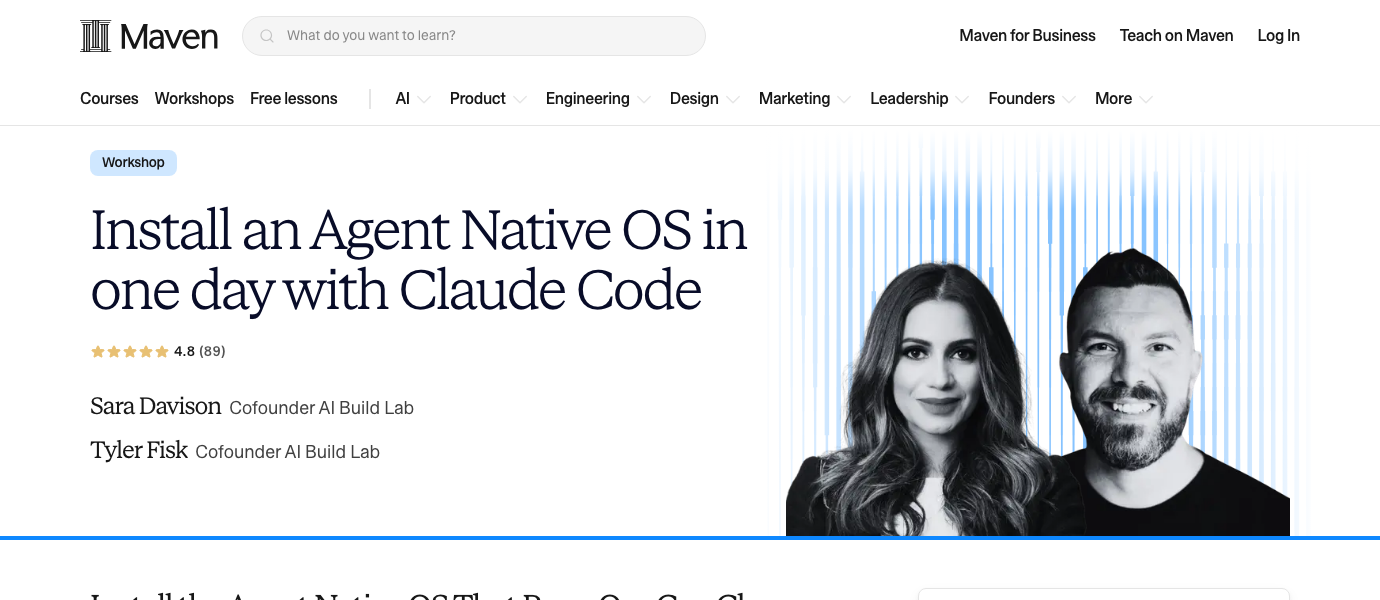
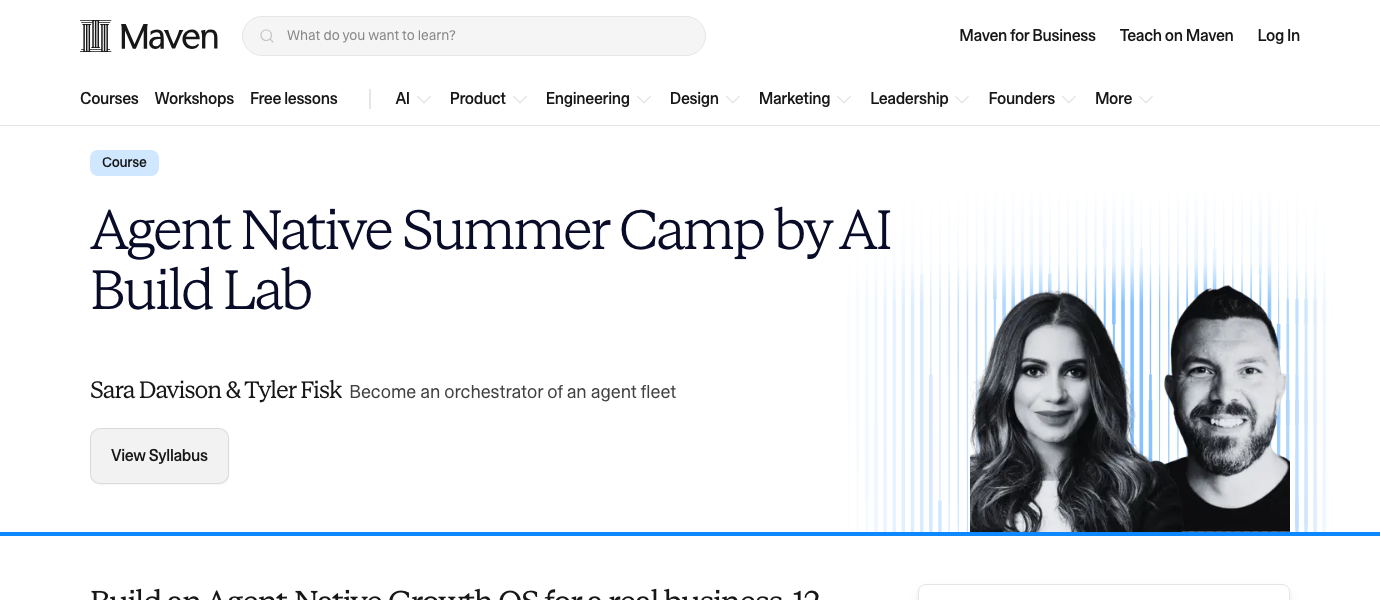
Not professors. Builders.
Five people who build this every day, in the room with you the whole time.
The agents don't wait
for you to wake up.
Overnight the fleet syncs, researches, drafts, and clears conflicts. By the time you pour your coffee, the morning brief is already waiting.
What the fleet shipped last week.
Not commits and PRs. Real outcomes: the systems, decks, and tools we put into the world.
- A full Learning Management System for the cohorts
- A mission control dashboard, hardened for daily ops
- A governance layer, realigned and cut over
- A client pitch deck, shipped live
- A deck-as-code studio any client drops into
- A CRM operator team, wired in
- An outreach + deal-flow engine
- A knowledge pipeline feeding all of it
- A texting chief of staff
All on fixed-cost compute, while we slept, taught, and lived our lives.
Five people do the work of twenty-five.
So who's watching the twenty-five?
The moment a small team produces like a big one, the output itself becomes the problem. Every draft, every decision, every dollar routes back through you. Speed without an operating layer breaks things: agents invent workflows, one failure cascades, and nobody can say why.
You scaled output 8x. Your oversight has to scale with it.
The missing layer is mission control.
The active system that sits above your fleet and does four things.
Everyone needs a chief of staff agent.
The hinge between driving every task and running an operation is a chief of staff. Ours is called Pepper. Anyone with a team of agents will need one: an agent whose only job is to do the roll-ups, protect your time, and be your single point of contact into the fleet.
A chief of staff is what turns a baseline OS into a mission control.
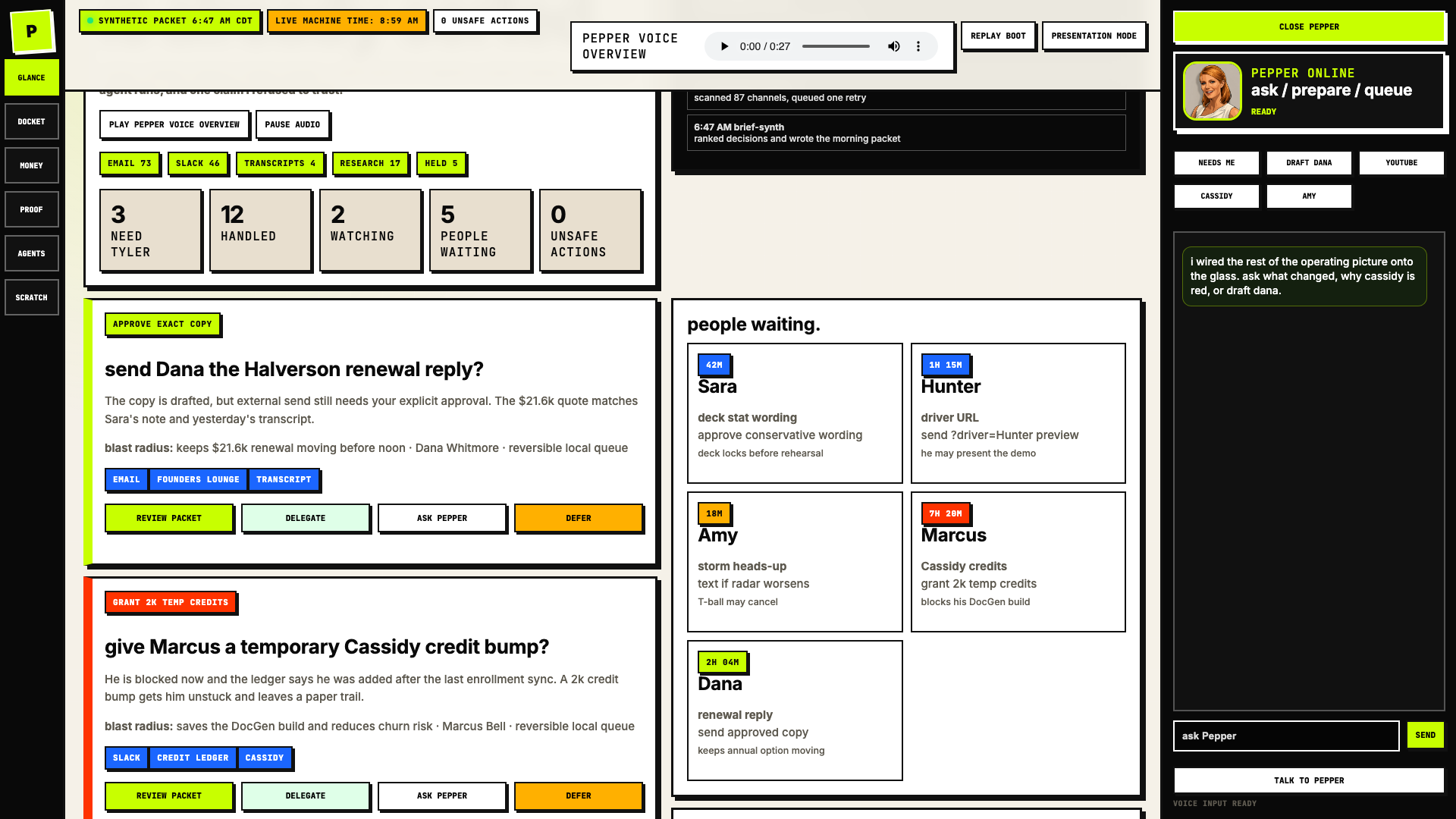
This is one of ours, running live.
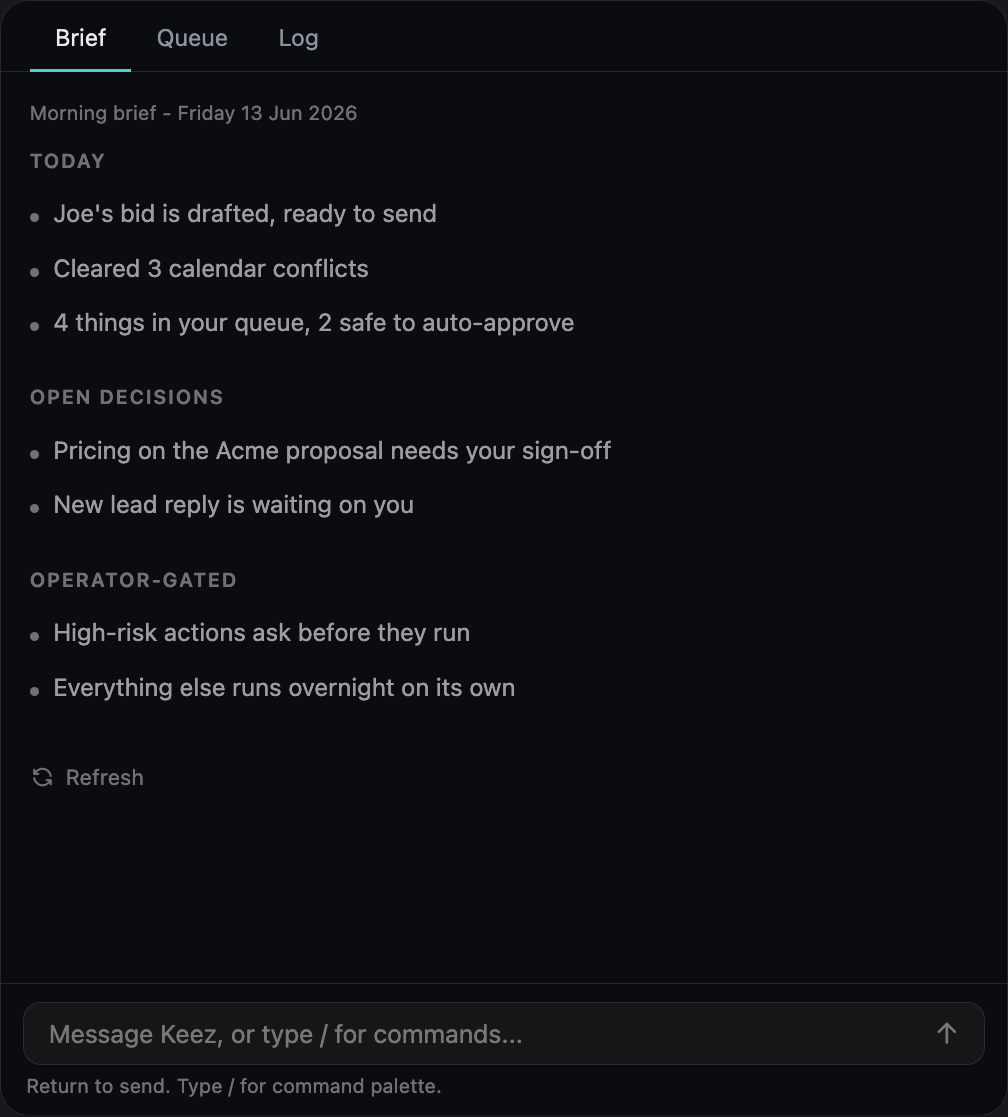
Two builds, one pattern. Hunter runs Keez, you'll see it next.
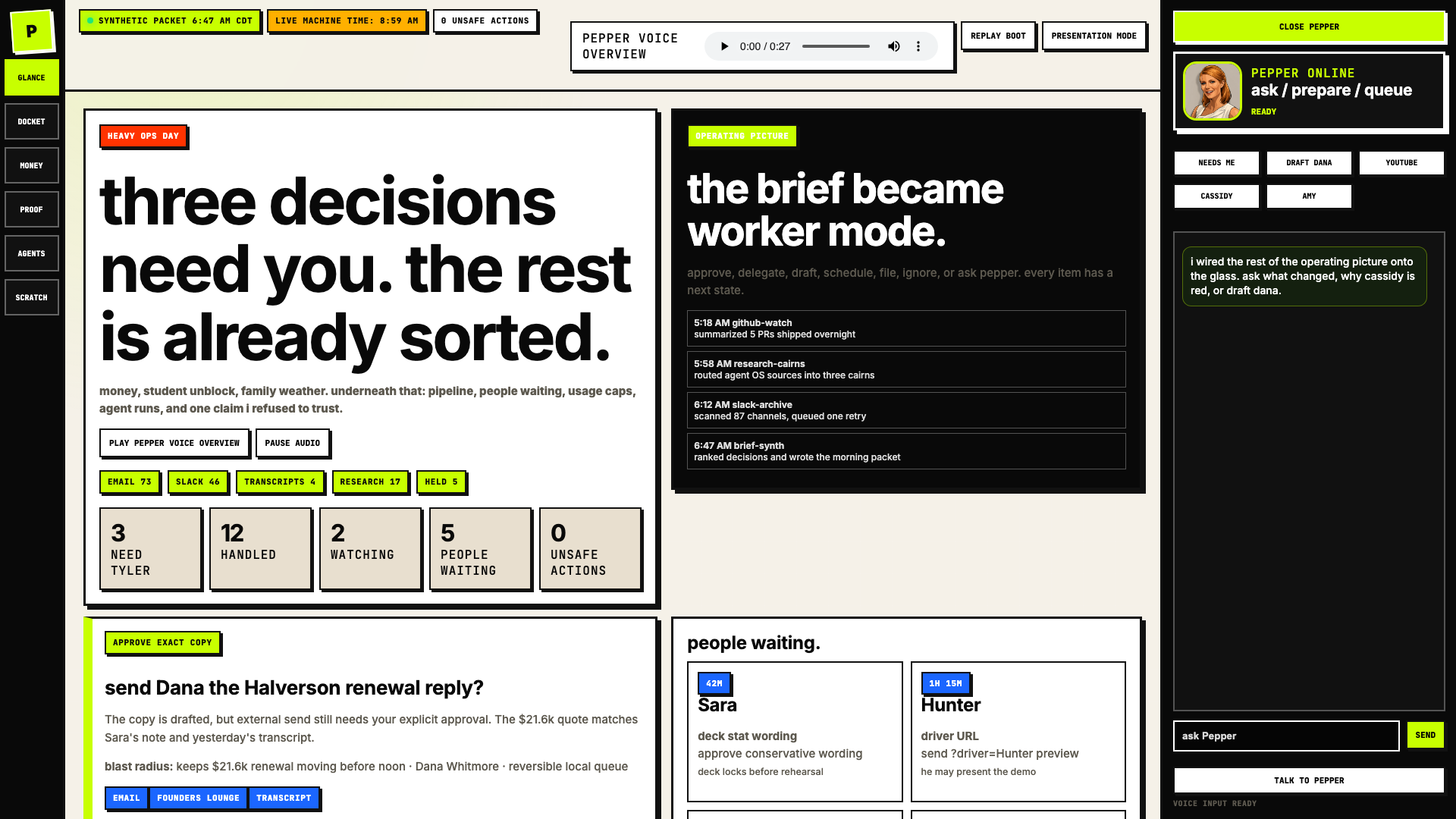
What's done, and what needs you.
Why an OS, not just Claude Code or Codex?
Claude Code and Codex are harnesses. A mission control is the layer above all of them, so you're never locked to one.
You're not picking a tool. You're building the layer that owns the tools.
The anatomy of a mission control.
The skill is knowing what each part looks like at the rung you're on.
| The parts | Baseline | What we teach | Full fleet |
|---|---|---|---|
| Chief of staff agent | None. You drive each task. | One agent that rolls up the work. | Pepper, above many agents. |
| Your agents | Ad-hoc prompts. | A few specialized agents: research, outreach, ops. | A coordinated fleet of specialized agents. |
| Memory & continuity | Notes in Obsidian. | Plus one channel to reach it anywhere. | Vector + graph memory, full ingestion. |
| See | Morning brief, raw output. | Roll-ups plus a simple dashboard. | Audit trail across the fleet. |
| Catch | Permission prompts. | Guardrails plus a reviewer checkpoint. | A dedicated real-time QA agent. |
| Direct | Re-prompt each session. | Tell the chief of staff to re-prioritize. | Priorities routed across the fleet. |
| Improve | Tweak prompts by hand. | A weekly review prompt. | Evals plus nightly self-improvement. |
| Runs on | One laptop, Claude Code. | Plus one always-on agent and a dashboard. | ~7 machines, many harnesses. |
Full visibility into the fleet.
Seeing starts with the chief of staff giving you a roll-up: what the fleet did, what's running, and what's waiting on your approval. Surfaced one thing at a time, most important first, so you never face a wall of output.
Stop problems before clients see them.
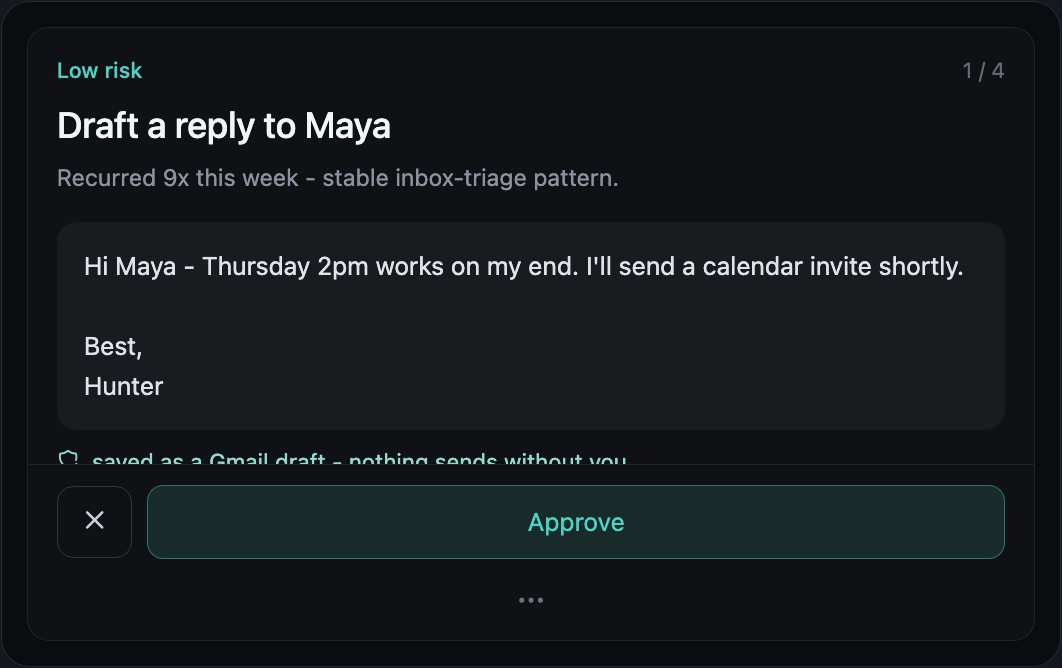
A fast fleet will confidently do the wrong thing. You catch it two ways: hard guardrails that decide what the agent can do alone versus what needs your sign-off, and a reviewer checkpoint that inspects work before it goes out.
Just because an agent can doesn't mean it should.
Re-steer the fleet mid-flight.
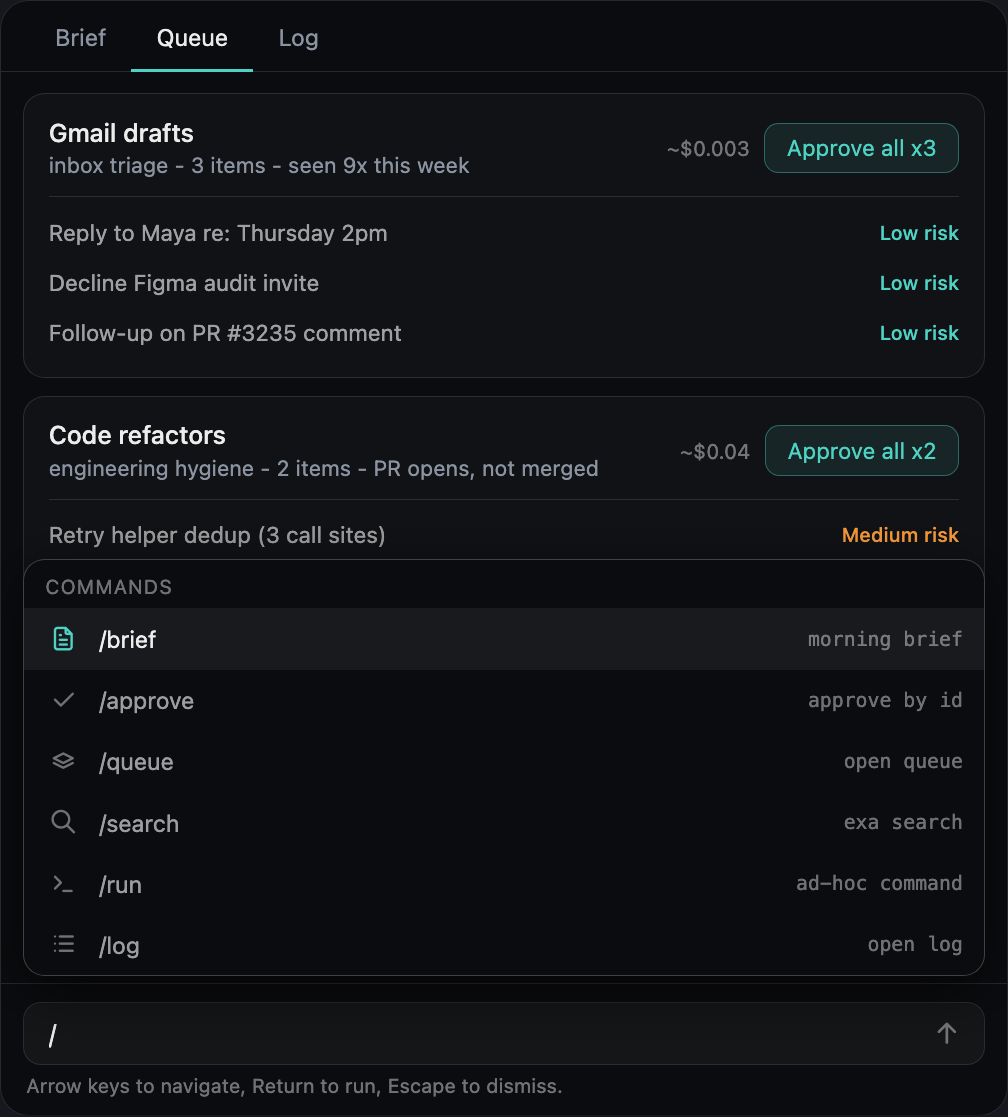
Priorities change halfway through the day. With a chief of staff you don't tear everything down. You tell it the new priority and it re-sequences the work, keeping what's already done.
You're the orchestrator. The chief of staff is the steering wheel.
The part most people miss.
Most people stop at reactive: see, catch, direct. The real unlock is making the fleet better on its own. At the rung we teach, that's a simple weekly review: ask the chief of staff what went wrong and turn each miss into a new guardrail for next week.
What the middle rung actually runs on.
You do not need seven machines or a fleet of named agents to have a real mission control. The rung we're teaching runs on what you already have. That's it.
Start with the chief of staff. Grow into the fleet.
What you're about to see.
Tyler talks to Pepper; Hunter builds a Keez-style page live, no code. Watch all four verbs in one motion.
We didn't start here.
Here's the whole thing.
The mission control you just saw sits on a seven-layer architecture. This is the one slide you're not meant to read: it shows the depth, it doesn't teach it.
You can give your clients a mission control too.
The same pattern becomes a front end you hand to a client. Our plumber, Joe, kicks off a job by texting an agent and watches a dashboard fill with his bid: research, pricing, provenance and all. He never logs into anything technical.
Kick off a job, watch it run, trust the output. That's a mission control you can sell.
Labor, 4 hrs $520
Permit + disposal $240
You climb to this. You don't leap.
Each era stacked on the last. You're on the newest rung, not starting over, and you climb it one step at a time.
The most valuable person in the room.
If every company is becoming agent-native, the people who can take them there are the rarest hire on the market.
That person isn't the engineer. It's the operator who learns to build this.
Two ways to take the next step.
- Morning brief + first agent wired
- Rules, connectors, memory set up
- Leave with a working OS
- Chief of staff agent, your use case
- Mission control interface, built live
- Client-ready or internal, your choice
Questions.
No. You describe what you want; the agents build it. The skill is orchestration, not programming.
No. Claude Code, one always-on agent, and a place to watch.
A morning brief. Then add the chief of staff to roll it up.
Math runs on deterministic tools. Trust is built through review and evals.
It runs off subscriptions. A scoped use case can run under $500/mo.
You came in able to prompt an agent.
You leave able to run a fleet.
- See — one roll-up of what your fleet did and what's waiting on you.
- Catch — guardrails and a reviewer before anything reaches a client.
- Direct — re-steer the whole fleet with one instruction.
- Improve — turn every week's misses into next week's guardrails.
Start with a chief of staff. Grow into the fleet. That is a mission control.